How to measure truck lift and wheel offset
Lift height and wheel fitment are the two measurements that decide whether a leveling kit, a lift kit or a set of wheels will work on your truck, and both are easy to measure badly. This guide gives a repeatable way to measure lift, explains leveling kits against lift kits, and covers offset, backspacing, bolt pattern and hub bore, including how to read a wheel you already own.
How to measure truck lift height
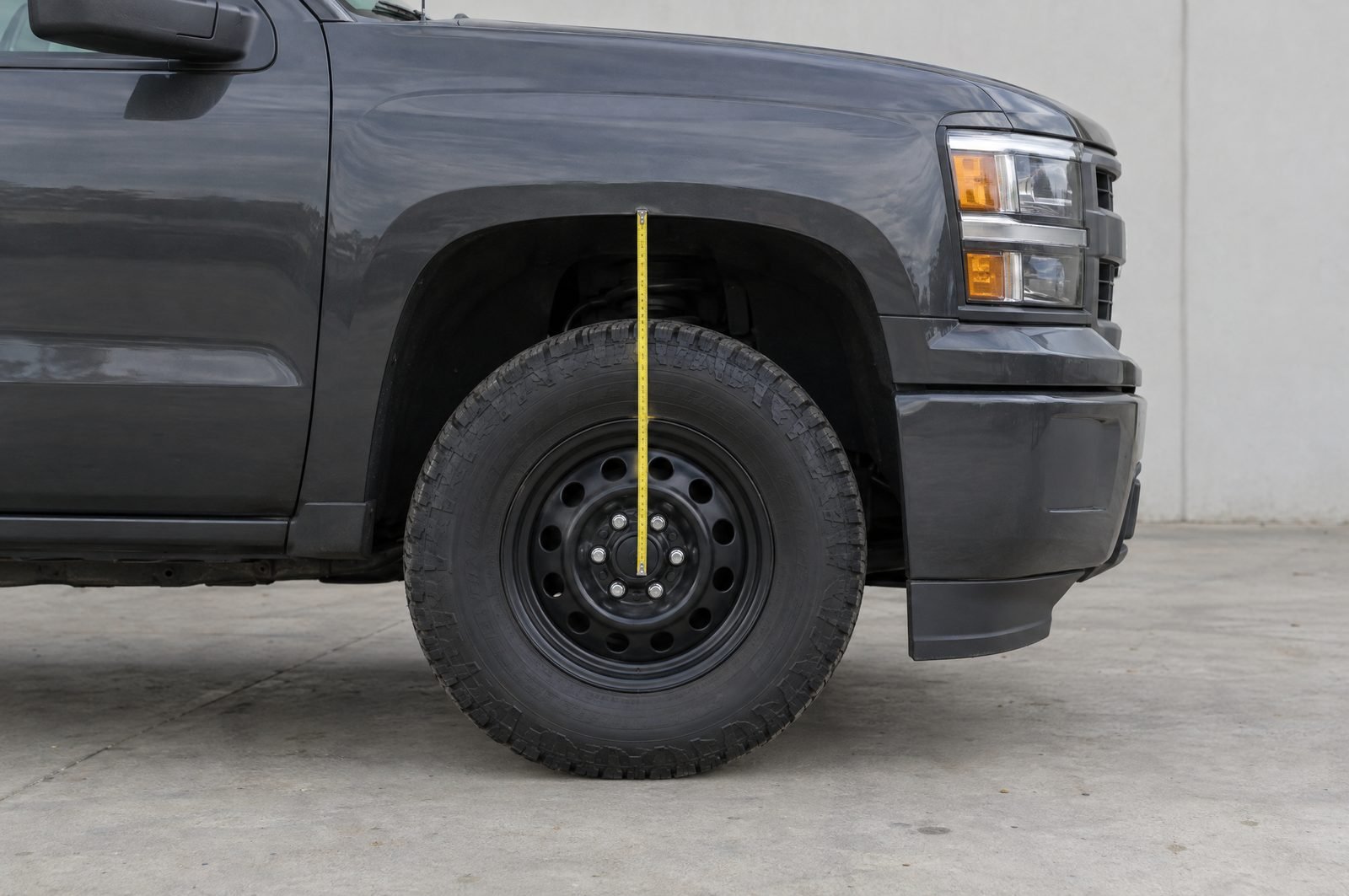
Measure from the center of each wheel hub straight up to the edge of the fender lip above it. Hub center to fender lip measures the suspension alone. A ground-to-fender number also moves with tire size and tire pressure, so it cannot tell you what a kit actually did.
- Park on level concrete with the wheels pointed straight ahead and the tires at the pressures printed on the door-jamb placard.
- Note the fuel level and what is in the cab and bed. Keep both the same when you measure again.
- Roll the truck a few feet forward and back, then let it sit, so the suspension is not holding a bind from the last turn.
- Measure hub center to fender lip at all four corners and write the four numbers down.
- After the kit is installed and the truck has been driven and settled, repeat the same steps. The change at each corner is your real lift, and the front-to-rear difference is your new rake.
Truck makers use the same idea. Ram's heavy-duty owner's manual has you measure from the top of the front wheel opening to the ground, before and after hooking up a trailer, to adjust a weight-distributing hitch.
Leveling kit vs lift kit
Many pickups leave the factory with the front sitting lower than the rear. A leveling kit raises the front to take out most of that rake and leaves the rear alone, or nearly so. A lift kit raises both ends, and a suspension lift usually replaces more parts than a leveling kit does. A body lift raises the body on the frame and leaves the suspension where it was. Browse both in leveling and lift kits.
Three checks before you choose either:
- Generation and trim. A kit made for the new-body 2019 Silverado 1500 does not fit the 2019 Silverado LD, which is the previous truck sold under a new name (see truck generations by year). Trims with their own suspension hardware often need their own kits; read the exclusions on each listing.
- Driver assistance. Ram's owner's manual warns that lift kits and other height modifications can limit the performance of the radar and camera used by adaptive cruise control and forward collision warning.
- Headlamp aim. Raising the front changes where the headlamps point. Federal lighting rules require headlamps to be mounted so their aim can be inspected and adjusted (49 CFR 571.108, S10.18.1), so re-aim them after any kit goes on.
Wheel offset and backspacing
Both numbers describe where the wheel's mounting surface sits, which decides how far in or out the tire sits under the fender.
- Offset is the distance from the mounting surface to the wheel's centerline, in millimeters. Positive offset puts the mounting surface toward the face of the wheel and tucks the wheel in. Zero puts it on the centerline. Negative moves it toward the back and pushes the wheel out toward or past the fender.
- Backspacing is the distance from the mounting surface to the wheel's back lip, in inches. More positive offset means more backspacing.
To convert one to the other, measure the overall width across the outside of both lips. Half of that is the centerline. Offset equals backspacing minus half the overall width. A wheel 9 inches wide overall with 5 inches of backspacing has its centerline at 4.5 inches, so its offset is plus 0.5 inch, which is 12.7 mm (0.5 times 25.4).
Bolt pattern and hub bore
A bolt pattern has two numbers: the lug count and the diameter of the circle through the lug holes, so 8x180 means eight lugs on a 180 mm circle. The hub bore, or center bore, is the hole in the middle of the wheel. A wheel with a bore larger than your hub can be centered with a hub ring, but a bore smaller than the hub will not go on at all.
| Truck (single rear wheel) | Model years | Bolt pattern | Hub bore |
|---|---|---|---|
| Ford F-150 | 2015 to present | 6x135 mm | 87.1 mm |
| Ford F-250, F-350 Super Duty | 1999 to present | 8x170 mm | 124.9 mm |
| Silverado 1500, Sierra 1500 | 1999 to 2026 | 6x139.7 mm | 78.1 mm |
| Silverado, Sierra 2500HD and 3500HD | 2011 to present | 8x180 mm | 124.1 mm |
| Ram 1500 | 2019 to present | 6x139.7 mm | 77.8 mm |
| Ram 1500 and 1500 Classic | 2009 to 2018; Classic 2019 to 2024 | 5x139.7 mm | 77.8 mm |
| Ram 2500, 3500 (Dodge Ram before 2010) | 1994 to present | 8x165.1 mm | 121.3 mm |
| Toyota Tundra | 2007 to 2021 | 5x150 mm | 110.1 mm |
| Toyota Tacoma | 2016 to 2023; 2024 to present | 6x139.7 mm | 106.1 mm; 95.2 mm |
| Jeep Gladiator | 2020 to present | 5x127 mm | 71.6 mm |
Dual rear wheel trucks differ: the F-350 dually from 2005 is listed at 8x200, the GM 3500HD dually from 2011 at 8x210, and the Ram 3500 dually from 2019 at 8x200. Also note that 8-lug does not mean interchangeable. Ford, GM and Ram heavy-duty trucks use three different 8-lug patterns.
How to measure a wheel you already have
- Read the back first. Most wheels have the offset stamped on the back side.
- Bolt pattern. Count the lug holes. On a 6-lug or 8-lug wheel, measure center to center across two holes directly opposite each other. A 5-lug wheel has no opposite hole; a bolt pattern gauge gives the accurate reading.
- Hub bore. Measure across the center hole at its widest point with calipers.
- Backspacing. Lay the wheel face down on something soft, set a straight board across the back lip, and measure from the mounting surface up to the board.
- Overall width. Measure across the outside of both lips, then work out offset as shown above.
Never fit a wheel whose bolt pattern does not match your hub, however close the numbers look. When your measurements are in hand, browse wheels, or send your VIN and measurements through the contact page and we will confirm the match before you order.
Sources
- Discount Tire: wheel offset and backspacing
- Discount Tire: how to measure a bolt pattern
- Discount Tire: hub-centric and lug-centric wheels
- Ram: 2020 Ram 2500/3500 owner's manual (fender height measurement; adaptive cruise notes)
- eCFR: 49 CFR 571.108 (FMVSS 108), S10.18 headlamp aimability
- GM TechLink: 2019 Silverado LD and Sierra Limited
- Stellantis: 2019 Ram 1500 press kit (6-lug pattern)
- Chevrolet Accessories: HD wheel listing, bolt pattern 8x180
- Ford Performance: F-150 wheel listing, 6 x 135 mm
- Ram Body Builder wheel sheet: 8 x 165.1 mm SRW, 8 x 200 mm DRW
- Wheel-Size bolt pattern listings: 6x135, 8x170, 6x139.7, 8x180, 5x139.7, 8x165.1, 5x150, 5x127, 8x200, 8x210