

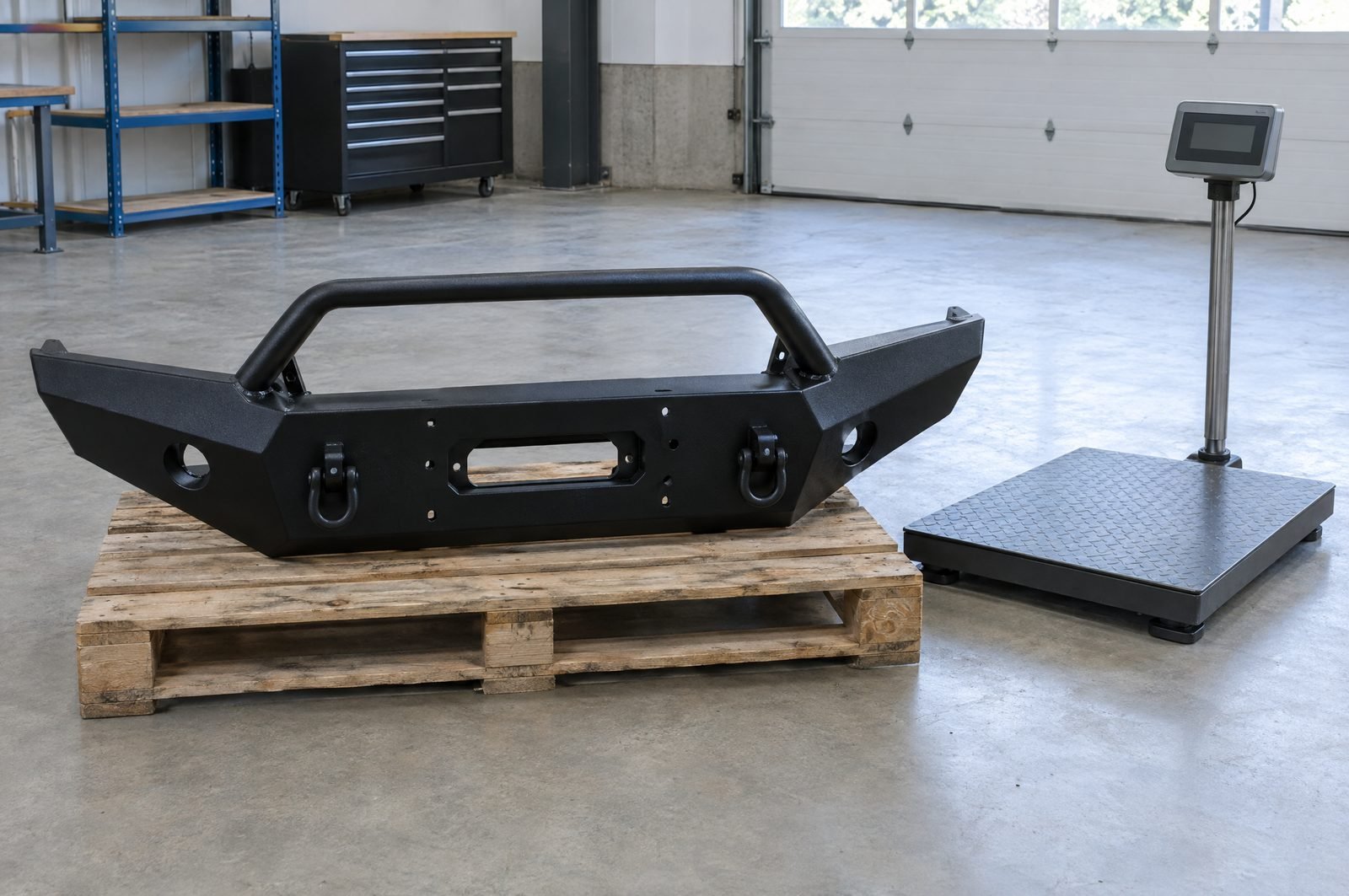
Steel bumper weight and front-end load on your pickup
A full-width steel replacement bumper for a full-size pickup can weigh more than 200 lb, and all of that weight hangs out in front of the front axle. Before you order one, it is worth knowing what it weighs, what a winch adds, how much load your front axle is rated to carry, and which sensors and cameras the bumper has to work around.
How much does a steel bumper weigh
Few bumper makers publish a product weight. Ranch Hand does, on the specification tab of each bumper, and its numbers for full-width steel front bumpers on full-size and heavy-duty pickups show the range:
| Ranch Hand front bumper | Fits (per the maker) | Published item weight |
|---|---|---|
| Legend Bullnose | Select Ford F-250, F-350 Super Duty | 210 lb |
| Summit with grille guard | Select Ford F-150 | 230 lb |
| Midnight with grille guard | Select Ford F-150 | 251.64 lb |
| Sport winch-ready with grille guard | Select Ford F-250, F-350 Super Duty | 276 lb |
| Legend with grille guard | Select Ford F-250, F-350 Super Duty | 282 lb |
| Sport winch-ready with grille guard | Select Silverado 2500 HD, 3500 HD | 298 lb |
The number that matters on your truck is the net change: the new bumper's weight minus the factory bumper that comes off. Factory bumper weights are rarely published, so the practical way to get it is to weigh the factory bumper on a shop or bathroom scale once it is removed, or ask the seller of a used factory bumper what it weighed.
A winch adds its own weight
A winch-ready bumper is rated for pulling load, not for carrying it. Ranch Hand's Sport bumpers, for example, have a winch mount "rated for 15,000 lbs. straight-line pull." That rating describes the mount's strength. The winch itself, its rope or cable, the fairlead and the control box all add weight on top of the bumper, and every pound of it sits ahead of the front axle. Take the winch weight from its maker's spec sheet and add it to the bumper's net change before you check your front axle rating. Winches and recovery gear are in winches and recovery.
Find your front axle rating (GAWR)
Look at the certification sticker in the driver's door opening. Under 49 CFR 567.4 it lists a gross axle weight rating (GAWR) for every axle, starting with the front one. The front GAWR is the most weight the front axle system is rated to carry.
- Fill the tank and load the truck the way you normally drive it, with people and tools aboard.
- Weigh the front axle on a commercial scale. Ram's owner's manual describes this method: weigh the whole truck first, then the front and rear separately.
- Subtract the front axle weight from the front GAWR. What is left is your margin.
- Compare the margin with the net weight of the bumper, winch and any lights you plan to mount.
If you tow, weigh again with the trailer hooked up. A weight-distributing hitch shifts part of the tongue weight onto the front axle by design, so the front margin you measured unhitched can shrink.
Why staying under GAWR matters
Ram's manual is direct about it: do not load the truck heavier than the GVWR or the maximum front and rear GAWR, because "parts on your vehicle can break, or it can change the way your vehicle handles," which can cause a loss of control. Its snowplow section adds that the loaded weight, "including the snowplow system, all aftermarket accessories," must stay within those ratings, and that front-end alignment was set at the factory without the plow's weight.
The same manual explains that each axle's GAWR is set by the component in that system with the lowest load capacity (the axle, springs, tires or wheels), and that heavier components added for durability do not necessarily raise the truck's ratings. Stiffer springs or a leveling kit can bring the nose back up, but the ratings on the label stay the ones the truck was certified with. A heavy bumper can also lower the front of the truck, which moves headlamp aim, so check the aim after installation.
Sensors, cameras and adaptive cruise
Many late-model trucks carry parking sensors, a front camera or the radar for adaptive cruise control in or near the factory bumper and grille. Ram's owner's manual says installing "a snow plow, front-end protector, an aftermarket grille or modifying the grille is not recommended" because it may block the sensor, and that brush and grille bars can hinder the system.
Bumper makers handle this differently by model, so read the specification lines. On Ranch Hand's listings, the Summit for the F-150 retains the front camera but not the parking sensors, the Sport for the Silverado HD retains the parking sensors but not the front camera, and the Legend for the Super Duty does not retain front camera function. Match those lines against the options on your truck.
Generation matters too. Ford's 2020 Super Duty refresh brought an improved front bumper and air dam, and the 2023 truck has an all-new exterior, so a bumper's listed years are part of the fit. Our generations guide explains these splits.
Browse front bumpers or grille guards, and send your VIN through the contact page if you want us to check fitment and sensor options before you order.
Sources
- Ranch Hand: Legend Bullnose front bumper, Super Duty (item weight 210 lb)
- Ranch Hand: Summit front bumper, F-150 (230 lb; camera and sensor notes)
- Ranch Hand: Midnight front bumper, F-150 (251.64 lb)
- Ranch Hand: Sport winch-ready bumper, Super Duty (276 lb; winch mount rating)
- Ranch Hand: Legend front bumper, Super Duty (282 lb; camera note)
- Ranch Hand: Sport winch-ready bumper, Silverado HD (298 lb; sensor notes)
- eCFR: 49 CFR 567.4, certification label (GVWR and GAWR)
- Ram: 2020 Ram 2500/3500 owner's manual (vehicle loading, snowplow, adaptive cruise)
- Ford: 2020 Super Duty refresh release (archived copy)
- Ford: 2023 Super Duty reveal (archived copy)


